

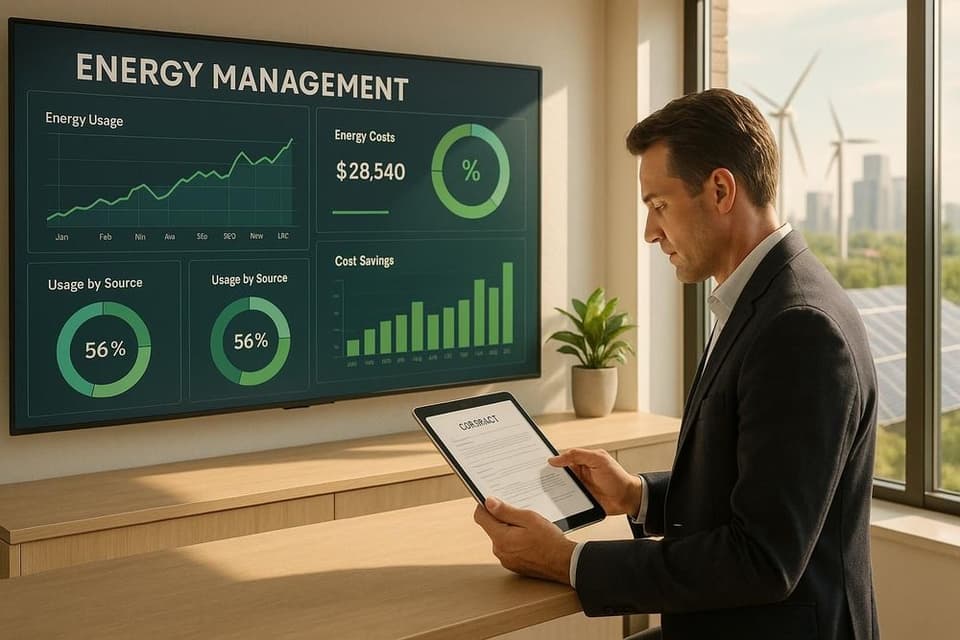
Energy-as-a-Service (EaaS) is transforming how businesses manage energy by offering subscription or usage-based models instead of upfront costs. Here's what you need to know:
- Key Benefits: EaaS shifts installation, maintenance, and performance responsibilities to providers, ensuring cost savings and efficiency.
- Payment Models: Options include performance-based payments, fixed subscriptions, usage-based billing, and risk-sharing mechanisms.
- Performance Guarantees: Contracts often promise specific outcomes, such as energy savings or reduced utility costs.
- Advanced Technology: IoT, AI, and smart grids enable real-time tracking, predictive maintenance, and energy optimization.
Quick Overview of Contract Types:
- Solar PPAs: Long-term agreements with fixed or variable payments based on energy production.
- Energy Efficiency Contracts: Focus on energy savings with performance guarantees. Includes ESPCs (customer-owned) and ESAs (provider-owned).
- Large-Scale Utility Models: Comprehensive solutions for utilities, including storage, generation, and management.
Quick Comparison Table:
| Feature | Solar PPA | Energy Efficiency Contracts | Large-Scale Utility Models |
|---|---|---|---|
| Cost Structure | No upfront capital | Energy savings-based | Variable, based on scope |
| Risk Allocation | Provider | Shared | Comprehensive |
| Service Scope | Solar generation | Efficiency upgrades | Full energy management |
| Performance Metrics | kWh production | Energy savings achieved | Multiple KPIs |
EaaS is growing rapidly - expected to reach $100.34 billion by 2030 - driven by demand for flexible, efficient energy solutions. Dive into the article for a detailed breakdown of contract structures, management practices, and strategies for maximizing value.
C&I Energy as a Service: What is the opportunity and how to capture it?
1. Solar PPA Contract Structure
Solar Power Purchase Agreements (PPAs) play a key role in renewable energy financing, offering long-term contracts (typically 10–25 years) where developers handle system operations, maintenance, and performance standards. Here's a closer look at the key elements, payment structures, and management practices that define these agreements.
Core Components
Solar PPAs rely on a pricing structure with two main payment elements, complemented by performance provisions:
| Component | Description | Impact on Portfolio |
|---|---|---|
| Availability Charge | A fixed fee ensuring baseline revenue for generation capacity | Provides consistent, predictable income |
| Output Charge | A variable fee tied to the actual electricity generated | Reflects system performance accurately |
To ensure financial stability, contracts often include minimum generation guarantees.
Payment Models and Risk Allocation
Solar PPAs typically follow one of two payment models, each with its own approach to risk and revenue distribution:
- Pay-as-Produced Model Payments are directly tied to the actual energy generated. For example, the University of Pennsylvania’s 220 MW solar facility is projected to produce around 420,000 MWh annually, meeting about 70% of the campus's power needs.
- Fixed Baseload Model This structure ensures steady payments and energy delivery, regardless of production variability. Premium pricing is applied to account for the provider's risk.
Contract Management Practices
Effective management is critical to ensuring the success of a Solar PPA. Key practices include:
- Technical Performance Monitoring Regularly track and evaluate system output to ensure it meets contractual benchmarks.
- Financial Structure Optimization Understand rate structures (fixed or escalating), ownership of green benefits, Solar Renewable Energy Credit (SREC) trading rights, and performance guarantee clauses to accurately assess project value and sustainability.
- Risk Management Keep a close eye on energy price fluctuations, system performance, compliance standards, and credit risk exposure to mitigate potential issues.
Documentation Requirements
To maintain clarity and accountability, a Division of Responsibility (DOR) document is essential. It should include:
- Maintenance schedules
- Performance reporting protocols
- Warranty claim procedures
- Compliance verification methods
This structured documentation ensures consistent management and reliable performance throughout the duration of the PPA.
2. Commercial Energy Efficiency Terms
Building on the foundation of Solar PPA frameworks, commercial energy efficiency contracts take energy management a step further by focusing on both performance optimization and cost savings. These agreements typically fall into two categories: Energy Savings Performance Contracts (ESPCs) and Energy Services Agreements (ESAs). Each approach comes with its own set of benefits, offering flexibility in managing energy portfolios. The differences between these contracts lie in areas like performance guarantees, payment methods, and ownership structures, making them essential to understand for effective energy management.
Contract Structure Comparison
| Feature | ESPCs | ESAs |
|---|---|---|
| Term Length | 10–20 years | 5–15 years |
| Equipment Ownership | Customer owned | Provider owned |
| Project Size | Typically >$1M | Flexible, including smaller projects |
| Payment Structure | Based on contracted services | Based on realized energy savings |
| Risk Distribution | Performance guaranteed by ESCO | Shared between parties |
Critical Contract Components
Performance Guarantees Guaranteeing energy savings is at the heart of these agreements. For instance, the Rockford Housing Authority utilized a $7.5 million ESPC to achieve annual savings exceeding $100,000 through targeted upgrades to its buildings.
Payment Structures Two main payment models dominate commercial energy efficiency agreements:
- Fixed-Rate Plans: These plans provide consistent, predictable costs, shielding clients from market volatility.
- Variable-Rate Plans: Costs adjust with market conditions, which could offer savings but require careful risk management.
Key Management Considerations
Usage Bandwidth Clauses These clauses set acceptable energy usage limits. If usage surpasses these limits, additional charges may be incurred.
Auto-Renewal Terms It's crucial to review auto-renewal clauses to avoid unintentional contract extensions or unexpected price adjustments.
"Usually in that type of system, [the ESCO will] guarantee the energy savings, and so the [money saved] is used to pay for the project cost and reduce the financial risk."
Performance Monitoring Modern building management systems (BMS) play a vital role in tracking energy efficiency. These systems monitor various factors in real time, such as temperature, weather, equipment performance, and even occupant behavior.
Fine-tuning these contract details can significantly improve energy portfolio outcomes, as illustrated below.
Implementation Success Factors
The city of Fort Worth showcased the potential of energy efficiency initiatives, achieving an estimated $65 million in savings by 2022 across its city-owned buildings. Key elements of their success included:
- Establishing clear baseline measurements
- Setting specific performance metrics
- Using advanced monitoring systems
- Documenting both energy and non-energy benefits
"We provide a service to our customers, not a particular product. That allows us to actually pick the best possible solution. It doesn't have to be a specific manufacturer."
3. Large-Scale Energy Service Models
Utility-level Energy-as-a-Service (EaaS) agreements take the principles of smaller-scale contracts and scale them up to encompass electricity supply, management services, and efficiency measures on a much larger scale. The rapid expansion of this sector is clear, with utility-scale storage capacity growing from 1,437 MW to 4,631 MW in 2021 alone. These models apply portfolio management strategies across entire utility networks, creating a more integrated approach.
Contract Framework Components
Utility-scale service agreements are typically structured around three main contract types:
| Contract Type | Key Features | Risk Allocation |
|---|---|---|
| Power Purchase Agreements | Covers full output with fixed pricing | Developer takes on performance risk |
| EPC Agreements | Direct utility ownership with turnkey solutions | Utility assumes development risks |
| Build-Transfer Agreements | Asset transfer post-completion | Risks are shared during transition |
These frameworks are designed to balance performance goals with risk management, ensuring smooth operations and accountability.
Performance Metrics and Scaling
Utility-scale projects require precise performance tracking to meet their ambitious goals. Key areas include:
Capacity Management: Optimizing storage capacity is crucial, especially since over 93% of new storage installations in 2021 were paired with solar facilities. Effective capacity management involves monitoring:
- Charging limits
- Storage duration
- Efficiency metrics
Risk Assessment Framework: Addressing risks is a top priority for large-scale projects. This mirrors earlier contract management strategies but with added complexity due to the scale. Ian McKinnon of Veriforce highlights the importance of compliance in this context:
"Compliance isn't just about adhering to laws; it's a strategic approach to risk management. By staying compliant, companies not only avoid legal penalties but also enhance their operational integrity and reputation".
Implementation Success Factors
Recent projects have shown how large-scale EaaS models can overcome financial and technical barriers to clean technology adoption. For example, BASE's Servetia initiative in April 2025 showcased the effectiveness of solutions like Frigg and Voltiris in driving innovation.
Operational Considerations: Several factors are critical to the success of these models:
- Technology Integration: Advanced monitoring tools are essential for tracking key parameters and optimizing network performance. Lithium-ion battery production is expected to grow over five-fold, reaching approximately 5,500 GWh by 2030.
- Compliance Management: Regular audits are necessary to ensure adherence to regulations. Non-compliance and poor contract management can cost organizations up to 9% of their annual revenue.
- Performance Optimization: As one industry expert explains:
"With EaaS, you typically do not own the power generation assets, reducing energy risk. Alternative arrangements, such as full ownership or financing options, are available".
Future-Proofing Strategies
To remain effective in the face of changing conditions, large-scale energy service models must incorporate strategies that ensure long-term success. The International Energy Agency predicts global renewable energy capacity will grow 2.7 times by 2030. Key steps for future-proofing include:
- Conducting regular technology-driven asset inspections
- Establishing clear maintenance priorities through criticality classifications
- Implementing robust weatherization protocols
- Developing detailed vegetation management plans
Model Comparison Analysis
Building on the contract structures and performance metrics discussed earlier, this section delves into a comparison of core Energy-as-a-Service (EaaS) models to help shape effective portfolio strategies.
Core Model Characteristics
Each EaaS model brings distinct benefits across critical operational dimensions. Here's a comparison of the key features of three prominent service models:
| Feature | Solar PPA | Commercial Energy Efficiency | Large-Scale Energy Service |
|---|---|---|---|
| Cost Structure | No upfront capital; fixed or escalating rate per kWh | Financed through energy savings | Variable based on service scope |
| Risk Allocation | Developer assumes performance risk | Shared between customer and provider | Comprehensive risk management |
| Service Scope | Solar generation only | Targeted efficiency upgrades | Full energy management suite |
| Performance Metrics | kWh production | Energy savings achieved | Multiple KPIs, including uptime |
Market Growth and Adoption
The EaaS sector is expanding rapidly, with Navigant Research estimating the commercial and industrial market will hit $221.1 billion by 2026. This growth stems from rising demand for flexible energy solutions and the increasing emphasis on sustainability.
"Energy-as-a-service (EaaS) is a business model whereby customers pay for an energy service without having to make any upfront capital investment".
Performance Guarantees and Service Integration
EaaS providers are now offering robust performance guarantees and bundled services to meet evolving market demands. The commercial segment, which is projected to account for about 69% of the total market share in 2024, showcases this trend. Providers like Schneider Electric are leading the way, as seen with the launch of GREENext in January 2024. This hybrid solution combines solar generation with battery storage technologies, illustrating how offerings are adapting to meet complex energy needs.
Financial Impact and Value Creation
The financial structure of EaaS models varies widely based on their scale and scope. Commercial buildings, for instance, contribute to approximately 22% of global electricity consumption. Factors such as risk-sharing, access to advanced technology, and cost predictability are driving adoption and creating value for stakeholders.
Technology Integration and Innovation
Modern EaaS solutions are increasingly defined by their integration of advanced technologies. By 2024, it’s expected that 77% of consumers in Europe will be connected to smart meters, enabling more precise energy management. A standout example is the collaboration between Enel X S.r.l. and Ferrari in Italy, which launched the country’s first Industrial Renewable Energy Community in Fiorano in May 2023. This project includes a 1 MW photovoltaic system capable of generating 1,500 MWh annually while cutting CO₂ emissions by around 650 kg per year.
These technological advancements highlight how integrated solutions are shaping the future of energy management, creating new possibilities for businesses and communities alike.
Market Outlook
EaaS models are evolving rapidly, paving the way for significant opportunities and reshaping contract strategies. Traditional utilities are transitioning into service-oriented providers by embracing integrated energy solutions, reflecting the dynamic changes in the energy market. These developments set the stage for actionable recommendations in the next section.
Key Findings and Recommendations
The analysis of EaaS portfolios highlights critical factors for evaluation and management. Building on the reviewed models, the following recommendations address strategies for portfolio development, risk management, and operational efficiency.
Strategic Portfolio Development
To align with the previously discussed contract structures and performance metrics, portfolio development should emphasize asset diversity and integration. Incorporating flexible assets can enhance stability. With renewable energy expected to account for 45% of total U.S. power generation by 2030, the focus should be on the following components:
| Portfolio Component | Strategic Value | Implementation Focus |
|---|---|---|
| Battery Storage | Price stabilization | Expand capacity to 110 GW by 2030 |
| Gas Generation | Peak load management | Cover 60–70% of peak load |
| Renewable Systems | Sustainability targets | Utilize off-balance sheet financing |
Risk Management Framework
Managing financial risks in EaaS portfolios calls for structured approaches, such as Energy Services Agreements (ESAs). For instance, Ameresco has secured over $3.5 billion in project financing through its portfolio management strategies. Key measures include:
- Performance Monitoring: Use standardized data systems for real-time tracking of operations.
- Contract Structuring: Leverage ESAs to shift operational and financial risks to service providers.
- Portfolio Diversification: Balance a mix of technologies and service models to mitigate overall risk.
"Get in fast, flag the biggest risks, manage those risks, and move on to the next thing."
- Jonathan Franz, Head of Legal, Crunchbase
Addressing top risks quickly allows organizations to focus on subsequent challenges, reinforcing earlier management practices.
Operational Excellence Guidelines
Data shows that 40–65% of HVAC systems in commercial portfolios are outdated and exceed their useful life. To achieve operational excellence, stakeholders should focus on:
- Infrastructure Modernization Invest in solutions that integrate analytics, generation, and storage. For example, upgrades in Fort Worth led to $65 million in savings.
- Contract Optimization Standardize contract templates and adopt e-signatures to cut contracting costs by up to 95%. Prioritize projects exceeding $250,000 to improve efficiency.
- Performance Verification Define clear performance metrics aligned with business goals, as demonstrated in prior case studies.
Value Creation Opportunities
Building on earlier performance monitoring practices, the Better Buildings program has proven the potential for value creation, completing over $450 million in EaaS projects between 2012 and 2019.
"This project will improve indoor air quality and temperature control, provide new virtual computer labs and advance our goal of approaching net-zero energy status. By partnering with Schneider Electric, we can achieve all this with no impact to taxpayers."
- Dr. Michael Gorman, President, Salem Community College
To maximize value, organizations should:
- Bundle smaller sites into larger contracts to secure better financing terms.
- Implement advanced data management systems for effective tracking.
- Establish performance metrics directly tied to business objectives.
- Structure contracts with flexibility to adapt to evolving technologies.
Additionally, the lighting-as-a-service market is projected to hit $2.6 billion by 2026, highlighting the growth potential for well-structured EaaS portfolios. Success in this area depends on a balance between embracing new technologies, managing risks effectively, maintaining operational excellence, and focusing on value creation.
FAQs
What are the key differences between Solar PPAs, Energy Efficiency Contracts, and Utility-Owned Models in terms of risk and services?
Solar Power Purchase Agreements (PPAs), Energy Efficiency Contracts, and Utility-Owned Models each approach risk-sharing and service offerings in distinct ways.
With a PPA, the developer takes on most operational risks, including maintenance and system performance, while customers benefit from steady energy costs without needing to make upfront investments. Energy Efficiency Contracts strike a balance, where the provider guarantees energy savings, but clients may still handle some operational duties. In contrast, Utility-Owned Models shift nearly all risks to the utility, which oversees performance, maintenance, and regulatory compliance.
When it comes to services, PPAs are centered on long-term energy generation at a fixed price, typically spanning 15–25 years. Energy Efficiency Contracts focus on cutting energy consumption and improving efficiency, often offering a variety of tailored solutions. Utility-Owned Models provide comprehensive services, managing everything from energy production and distribution to customer relations, much like a traditional utility setup.
What are performance guarantees in Energy-as-a-Service contracts, and what happens if energy savings fall short?
In Energy-as-a-Service (EaaS) contracts, performance guarantees are commitments from energy service providers to achieve a specific level of energy savings. These guarantees are meant to reassure customers that their investment in energy solutions will lead to tangible, measurable results.
If the promised savings aren't met, the service provider usually has to make it right. This could mean reimbursing the customer directly or adjusting future service fees. Such measures ensure customers are financially protected and hold the provider accountable for delivering on their promises.
EaaS contracts also typically include ongoing monitoring and maintenance. This continuous oversight ensures that energy savings are consistently achieved and that systems remain efficient and reliable throughout the agreement's duration.
How do advanced technologies like IoT and AI improve the management of Energy-as-a-Service (EaaS) contracts?
Advanced technologies like IoT and AI are transforming how Energy-as-a-Service (EaaS) contracts are managed, making operations smarter and more efficient. AI analyzes massive amounts of data from IoT devices to forecast energy demand, optimize energy distribution in real-time, and identify potential issues before they become expensive problems. This helps maintain grid stability and supports the adoption of renewable energy, aligning with broader sustainability goals.
IoT devices, such as smart meters and sensors, play a key role by continuously monitoring and collecting data. This real-time information enables predictive maintenance and boosts energy efficiency. With these insights, energy providers can cut operational costs, simplify contract management, and quickly respond to market and regulatory changes. Together, IoT and AI create a powerful combination that not only strengthens portfolio management but also builds a more dependable and sustainable energy system.
Related Blog Posts
- Structuring Deals for Acquiring Solar Panel Loan Portfolios
- Portfolio Analysis: Factors Affecting the Value of Terminated Contracts in the Energy Sector
- Due Diligence Methodology for Evaluating Leasing Portfolios in the Energy Sector
- Automated Systems for Evaluating Debt Portfolios in the Energy Sector: Comparative Analysis
