

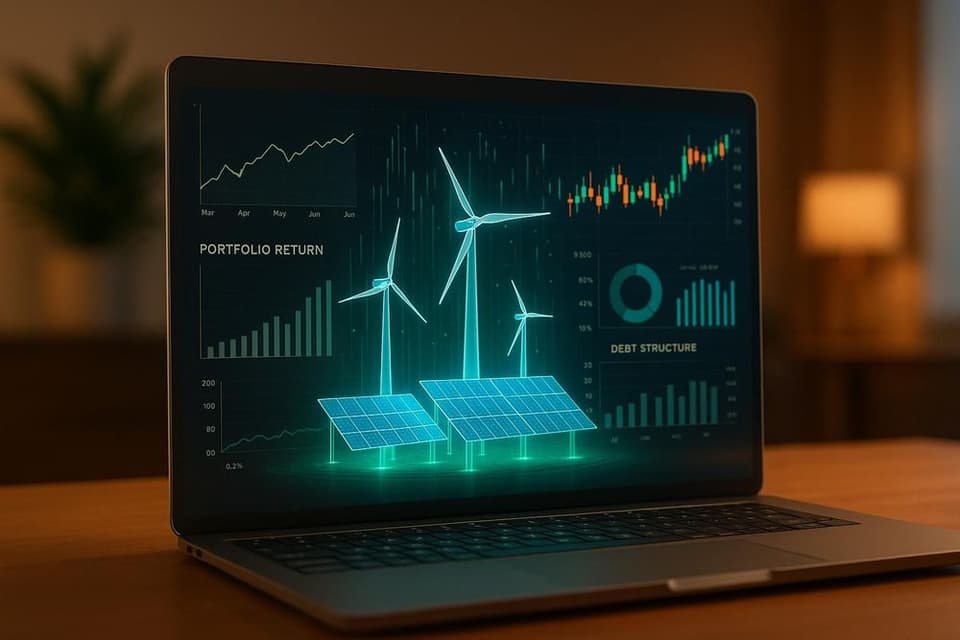
Digital twins are changing how energy debt portfolios are managed by combining real-time data from energy assets with financial modeling. This technology helps predict risks, track energy production, and improve cash flow analysis. Key benefits include:
- Real-time Monitoring: Sensors collect data to minimize downtime and reduce costs.
- Financial Insights: Accurate cash flow projections and debt service analysis.
- Risk Assessment: Simulating weather, equipment performance, and market conditions.
- Cost Savings: Companies like GE and Endeavour Energy report billions saved through proactive monitoring.
With the digital twin market expected to grow from $3.1 billion in 2020 to $48.2 billion by 2026, this tool is reshaping investment strategies and risk management in the energy sector. By integrating operational and financial data, businesses can make smarter, more informed decisions that maximize returns.
Ep 208: Ciaran Flanagan– Digital Twins, AI, & the Energy Trilemma: Molding Data Centers for Tomorrow
Key Elements of Digital Twin Systems
Digital twin systems rely on several critical components to effectively model energy debt portfolio returns. These elements work in harmony to provide a detailed understanding of both physical asset performance and financial outcomes.
Physical and Financial Data Integration
At the heart of a successful digital twin system is the seamless integration of physical sensor data and financial metrics. This combination ensures accurate and actionable insights.
A cloud-based platform serves as the backbone, connecting physical asset data with financial modeling. This integration enables:
| Integration Component | Function | Business Impact |
|---|---|---|
| Real-time Monitoring | Continuous collection of sensor data | Minimizes unscheduled downtime costs |
| Financial Modeling | Cash flow projections and debt service | Increases accuracy in portfolio valuations |
| Risk Assessment | Physical-financial risk scoring | Supports better investment decisions |
By fusing these data streams, the system creates a solid foundation for precise energy production tracking.
Energy Production Tracking
Digital twins leverage sensor networks and weather data to monitor energy production with remarkable accuracy. A great example is Reuniwatt's SunSat™ Digital Twin, which offers:
- 15-minute interval monitoring
- Coverage with 1 km² spatial resolution
- Detailed irradiance and production tracking
- Revenue analytics and asset management tools
The system incorporates plant-specific characteristics, solar radiation data, and external factors like temperature to produce highly accurate production estimates.
Energy Output and Cash Flow Analysis
Once production data is tracked, digital twins translate it into actionable financial insights. As DNV explains:
"The digital twin is a virtual image of an asset, maintained throughout the lifecycle and easily accessible at any time".
With this real-time data, businesses can perform cash flow analysis and build reliable portfolio return models.
The link between energy output and financial performance is highlighted through:
| Analysis Component | Metrics Tracked | Financial Impact |
|---|---|---|
| Production Analysis | Daily/monthly output vs. projections | Tracks revenue variances |
| Performance Ratios | Actual vs. expected yield | Assesses debt coverage |
| Health Monitoring | Trends in equipment efficiency | Forecasts maintenance costs |
These interconnected components refine portfolio return models, making them more precise and actionable.
Risk Analysis Methods
Digital twins play a key role in improving risk assessment for energy debt portfolios by combining simulations with real-time monitoring. These methods build on earlier discussions about tracking energy production and analyzing cash flows, completing a framework that seamlessly integrates physical and financial data.
Portfolio Stress Testing
Digital twins enhance stress testing by simulating a variety of factors like weather patterns, equipment performance, and market conditions - all at the same time. This enables lenders to gauge how resilient a portfolio might be under different scenarios.
| Stress Test Component | Variables Analyzed | Risk Impact Assessment |
|---|---|---|
| Weather Patterns | Historical trends, seasonal changes | Forecasting production stability |
| Equipment Performance | Failure rates, upkeep schedules | Estimating operating costs |
| Market Conditions | Energy price shifts, demand changes | Evaluating revenue reliability |
For example, a global energy company recently used digital twin technology to optimize renewable projects. This analysis uncovered an opportunity to boost net present value by $500 million, providing more precise risk insights and enabling better financing decisions. Beyond stress testing, digital twins also refine asset valuations through dynamic, ongoing evaluations.
Collateral Valuation Models
Digital twins revolutionize collateral valuation by continuously monitoring asset performance, efficiency metrics, and market trends. This approach has been shown to cut production costs by 5% to 15% through operational optimizations.
Key risk factors - like weather variability, equipment reliability, and evacuation schedules - are swiftly analyzed to understand their financial impact:
| Assessment Factor | Evaluation Metrics | Value Impact |
|---|---|---|
| Weather Patterns | Variability in energy production | Revenue consistency |
| Equipment Failure | Likelihood of downtime | Maintenance expense forecasting |
| Evacuation Schedules | Grid reliability assessments | Predictability of cash flow |
Setting Up Digital Twin Systems
Establishing digital twins requires seamless OT-IT integration. Recent advancements in open technologies and generative AI have significantly improved financial modeling capabilities. To fully leverage these tools, a well-structured system that prioritizes risk and performance analysis is essential.
Data Standards and Protocols
Strong data standards form the backbone of effective OT-IT integration. Clear protocols addressing latency, accuracy, security, and compliance are key to ensuring smooth operation.
Here’s a breakdown of critical integration requirements:
| Data Type | Integration Requirements | Key Considerations |
|---|---|---|
| Real-time Equipment | OT system connectivity | Latency and reliability |
| Asset Management | IT system integration | Data accuracy and completeness |
| Financial Data | ERP system connection | Security and compliance |
| Production Metrics | Plant lifecycle systems | Historical data preservation |
A great example of this in action is the Smart Energy Network Demonstrator project in the UK. By implementing clear data standards and leveraging open-source solutions, they achieved a 56% reduction in curtailment, highlighting the power of precise data integration and standardization.
Connecting with Portfolio Tools
For digital twins to deliver meaningful results, they must integrate seamlessly with existing portfolio management tools. This integration focuses on three critical areas:
- Data Quality Management: Power meter data and network models should be validated using simulated measurements to ensure accuracy and reliability.
- Model Verification: Digital twin models need regular checks against real-world performance to confirm energy production estimates, financial forecasts, and underlying assumptions.
- System Integration: Open technologies are essential for flexible connections with existing systems. They support real-time data synchronization, automated reporting, and dynamic portfolio analysis.
Generative AI has added a new dimension to these systems by enabling advanced scenario modeling, offering deeper insights into portfolio performance.
| Integration Component | Primary Function | Business Impact |
|---|---|---|
| Real-time Monitoring | Performance tracking | Immediate issue detection |
| Predictive Analytics | Future state modeling | Improved risk assessment |
| Financial Integration | Portfolio valuation | Accurate return forecasting |
| Automated Reporting | Compliance documentation | Simplified auditing |
Meeting Regulatory Requirements
Digital twin systems supporting DOE Title XVII clean energy projects must align with federal regulations, including the guidelines outlined in 10 CFR Part 609, which cover evaluation processes, financial modeling, and risk assessment practices.
Model Audit Standards
To comply with DOE requirements, digital twin models need to follow strict audit protocols. These include well-defined validation procedures, real-time data integrity checks, and thorough documentation. This ensures the models accurately reflect asset performance and financial outcomes, providing a reliable basis for evaluations.
Debt Coverage Ratio Monitoring
Regulatory compliance also demands continuous tracking of critical financial metrics, such as debt service coverage ratios. By combining real-time energy production data with ongoing financial analysis, digital twin systems can identify potential issues early. This integration helps facilitate DOE assessments of project eligibility, financial health, and adherence to regulatory standards.
Conclusion
Digital twin technology is reshaping how energy debt portfolios are managed by combining real-time monitoring with advanced financial modeling. The global digital twin market in the energy sector is expected to expand significantly, growing from $3.1 billion in 2020 to $48.2 billion by 2026. These figures highlight the financial opportunities available to portfolio managers leveraging this technology.
Organizations using digital twins have reported impressive results: a 15% reduction in carbon emissions, a 2–4% improvement in asset performance, and a 15% decrease in operation and maintenance costs. These measurable benefits translate directly into stronger portfolio performance through better efficiency and risk control.
"To improve your environmental performance, reduce energy use etc, the first thing you need to do is measure the real-world situation, recurrently, so you know what's going on. Making a digital model of that enables you to make real-world decisions and optimize things."
- Frank Suykens, Senior Vice President of Visual Computing at Hexagon
This statement emphasizes the importance of consistent and accurate measurement. Successfully implementing digital twins in portfolio management depends on prioritizing high-quality data, fostering collaboration across teams, and defining clear objectives. By integrating real-time operational data with financial insights, managers can make informed decisions that maximize returns.
The industry is projected to grow at an impressive 61.3% compound annual growth rate (CAGR), increasing from $10.1 billion in 2023 to $110.1 billion by 2028. As the technology continues to advance, its ability to merge physical operations with financial data will transform investment strategies and redefine how risks are managed.
FAQs
How do digital twins combine physical sensor data with financial insights to enhance energy debt portfolio management?
Digital twins leverage real-time sensor data from physical assets - like solar installations - to build a virtual model that mirrors their performance. These digital replicas combine key operational metrics, such as energy production, maintenance requirements, and surrounding conditions, with financial details like cash flow forecasts and debt repayment plans.
By running simulations across different scenarios, digital twins help uncover potential risks, fine-tune asset performance, and provide more precise portfolio valuations. This approach supports smarter decisions in managing energy debt portfolios, leading to steadier returns and reduced financial uncertainty.
What are the key advantages of using digital twins for assessing risks and stress testing in energy debt portfolios?
Digital twins bring a new level of precision to risk assessment and stress testing in energy debt portfolios by simulating asset performance with incredible accuracy. By combining real-time data from physical assets - like solar panels - with financial models, they enable more reliable predictions of portfolio returns and help spot risks before they escalate.
These tools are especially useful for stress testing in various scenarios, such as shifts in energy production or volatile market conditions. This empowers portfolio managers to make well-informed decisions. Beyond that, digital twins enhance transparency, simplify monitoring processes, and reduce uncertainty, offering a powerful way to fine-tune portfolio performance.
What steps can companies take to ensure regulatory compliance when using digital twin systems in energy projects?
To ensure compliance with regulations when adopting digital twin systems for energy projects, companies should prioritize a few critical steps:
- Stay Informed About Regulations: Keep up-to-date with both local and federal rules in the U.S., including those related to energy efficiency, data privacy, and environmental standards. Knowing these guidelines is essential to avoid legal pitfalls.
- Ensure Secure Data Management: Make sure your digital twin system handles data responsibly - this includes secure collection, processing, and storage in line with privacy and cybersecurity laws.
- Consult Industry Professionals: Partner with legal and regulatory experts to review your digital twin setup. Their insights can help ensure your system complies with all applicable regulations.
Addressing these aspects upfront allows companies to confidently implement digital twin technology in their energy initiatives while staying within the bounds of regulatory requirements.
Related Blog Posts
- Acquisition Strategies for Debt Accounts in the Solar Energy Sector
- Portfolio Diversification Strategies: Combining Different Types of Debts in the Energy Sector
- Forecasting Models of Debt Portfolio Profitability in the Solar Energy Sector
- Automated Systems for Evaluating Debt Portfolios in the Energy Sector: Comparative Analysis
