

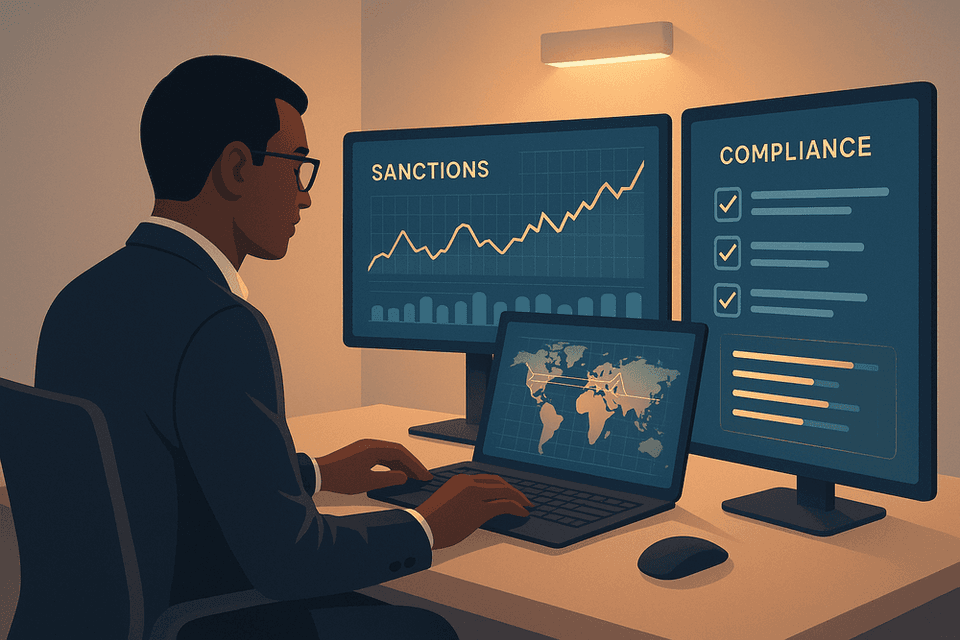
Sanctions monitoring ensures compliance with U.S. laws by identifying prohibited entities in debt trading. Non-compliance risks legal penalties, financial losses, and reputational harm. Here's what you need to know:
- Key Agencies: OFAC (enforces sanctions) and FinCEN (monitors financial security).
- Monitoring System Essentials: Screening tools, risk assessment, documentation, alerts, and audit trails.
- Automation vs. Manual: Automated systems are faster and more reliable but require upfront investment.
- AML/CTF Integration: Combine sanctions checks with anti-money laundering and counter-terrorist financing efforts.
- Technology Tools: Real-time screening, risk scoring, and reporting systems integrated with trading platforms.
Compliance requires staff training, regular audits, and detailed record-keeping. Future advancements will improve accuracy and handle emerging challenges like digital assets. Stay prepared by adopting modern tools and aligning with regulatory updates.
U.S. Sanctions Laws and Regulators
Main Regulatory Bodies
In the U.S., two key federal agencies are responsible for enforcing sanctions in the realm of debt trading:
- OFAC (Office of Foreign Assets Control): Operating under the U.S. Treasury, this agency enforces sanctions against specific governments, organizations, and individuals.
- FinCEN (Financial Crimes Enforcement Network): This agency complements OFAC by monitoring financial security measures, such as suspicious activity reports and anti-money laundering practices.
Together, these agencies create the foundation for enforcing sanctions and ensuring compliance within debt trading activities.
OFAC Overview
OFAC
Creating a Sanctions Monitoring System
Building on the basics of U.S. sanctions law, a monitoring system ensures compliance by turning these principles into actionable processes.
Key Components
An effective sanctions monitoring system includes the following elements:
- Screening Infrastructure: A database to match transaction data against various sanctions lists.
- Risk Assessment Framework: A structured method to evaluate the risk levels of debt portfolios, counterparties, and transactions.
- Documentation System: Secure storage for due diligence records, transaction histories, and compliance reports.
- Alert Management: A system to flag possible sanctions violations and route them to the appropriate personnel for review.
- Audit Trail: Detailed logs of all screening activities, decisions, and actions.
Manual vs. Automated Systems
When deciding between manual and automated monitoring systems, consider the following:
| Aspect | Manual Monitoring | Automated Monitoring |
|---|---|---|
| Cost | Lower initial costs | Higher upfront investment |
| Speed | Slower processing | Real-time screening |
| Error Rate | Higher risk of mistakes | Fewer errors |
| Scalability | Limited by staff capacity | Easily scalable |
| Flexibility | Better with complex cases | Rule-based, less adaptable |
| Resource Needs | Labor-intensive | Technology-focused |
For operations with high transaction volumes, automated systems often deliver better efficiency and reliability. A hybrid approach, combining automation with human oversight, can offer the best of both worlds.
AML and CTF Integration
Combining sanctions monitoring with Anti-Money Laundering (AML) and Counter-Terrorist Financing (CTF) efforts strengthens the compliance framework.
Unified Screening Process Integrate sanctions, AML, and CTF checks into a single workflow. Share relevant data across compliance functions and standardize risk assessment criteria to ensure consistency.
Consolidated Reporting
- Produce reports that address all regulatory requirements.
- Monitor performance indicators across sanctions, AML, and CTF processes.
- Maintain a unified audit trail to simplify regulatory reviews.
Resource Optimization
- Train compliance staff to handle sanctions, AML, and CTF responsibilities.
- Use shared technology and data storage systems.
- Simplify investigation and escalation processes.
Clear communication channels and standardized documentation are essential for smooth coordination across all compliance activities.
Tools and Methods for Compliance
Effective compliance combines established monitoring systems, clear procedures, and advanced technology to ensure accuracy and efficiency.
Compliance Methods
Successful sanctions monitoring depends on skilled staff and well-defined processes. Key methods include:
Staff Training
- Annual certification on OFAC regulations
- Quarterly updates on sanctions changes
- Role-specific training for compliance officers, traders, and support teams
- Comprehensive documentation of all training sessions and evaluations
Audit Practices
Regular audits are vital to maintaining effective monitoring systems. Essential steps include:
- Daily: Reviewing screening results and escalations
- Weekly: Checking the quality of alert investigations
- Monthly: Testing system accuracy with sample cases
- Quarterly: Conducting a full review of compliance programs
Record-Keeping Guidelines
Detailed documentation must be maintained for at least five years. Here's an overview:
| Document Type | Retention Period | Review Frequency |
|---|---|---|
| Transaction Records | 7 years | Monthly |
| Screening Results | 5 years | Quarterly |
| Investigation Reports | 5 years | Semi-annually |
| Training Records | 5 years | Annually |
| Audit Reports | 7 years | Annually |
While manual processes are critical, technology plays a major role in automating and streamlining compliance efforts.
Technology Solutions
Modern compliance requires technology capable of managing complex and dynamic screening needs efficiently.
Key Software Features
- Real-time screening across multiple sanctions lists
- Automated alert creation and routing
- Customizable risk scoring systems
- Comprehensive audit trail capabilities
- Integration with existing trading platforms
System Integration
1. API Connectivity
Seamless integration with government sanctions databases, third-party compliance tools, and internal systems ensures smooth operations.
2. Data Management
Robust data handling features include:
- Secure storage of sensitive data
- Automated updates to sanctions lists
- Historical transaction archives
- Detailed audit logs
3. Reporting Tools
Advanced reporting options allow for:
- Customizable report creation
- Automated compliance alerts
- Risk assessment summaries
- Support for regulatory filings
Performance Tracking
Measure system effectiveness with metrics like:
- False positive rates
- Alert resolution times
- System uptime
- Response speed
For debt trading platforms, automated sanctions checks should be integrated at every stage, including:
- Initial portfolio uploads
- Pre-trade evaluations
- Transaction execution
- Post-trade monitoring
Looking Ahead
Key Takeaways
Effective sanctions monitoring relies on a combination of regulatory compliance, advanced technology, and strong internal controls. Core practices include:
- Screening against sanctions lists like OFAC, UN, and EU.
- Integrating monitoring systems directly with trading platforms.
- Regularly training staff to stay updated on compliance requirements.
- Keeping detailed documentation and audit trails for accountability.
These foundational practices set the stage for future developments in both technology and regulatory frameworks.
What’s Next?
The future of sanctions monitoring is shaped by advancements in technology and shifts in regulatory policies. As compliance systems become more sophisticated, their capabilities will expand even further.
Technological improvements, such as natural language processing, will refine name-matching accuracy. Real-time updates and improved integration features will make monitoring systems more responsive. Automated risk scoring tools are also on the horizon, simplifying how transaction risks are assessed.
Regulatory changes may address challenges tied to digital asset transactions and cross-border coordination. Companies like Debexpert are committed to evolving their solutions to meet these new standards, ensuring compliance remains seamless and effective.
FAQs
What’s the difference between manual and automated sanctions monitoring, and how can I choose the right approach for my organization?
Manual sanctions monitoring involves human review of transactions and debt portfolios to ensure compliance with regulations, while automated systems use technology to scan and flag potential risks in real time. Manual systems can be more flexible but are labor-intensive and prone to human error. Automated systems, on the other hand, are faster, more consistent, and scalable for handling large volumes of data.
To decide which is best for your organization, consider factors like the size of your operations, the complexity of your compliance needs, and your budget. For example, smaller organizations with fewer transactions might manage with manual processes, while larger institutions often benefit from the efficiency and accuracy of automation. Regardless of the approach, staying compliant with sanctions regulations is critical in debt trading to avoid legal and financial risks.
How does combining sanctions monitoring with AML and CTF measures improve compliance in debt trading?
Integrating sanctions monitoring with Anti-Money Laundering (AML) and Counter-Terrorism Financing (CTF) efforts strengthens compliance by ensuring a more comprehensive risk management approach. This integration helps identify and mitigate potential risks related to sanctioned entities or illicit activities more effectively.
By aligning these processes, debt traders can:
- Stay compliant with regulatory requirements, avoiding penalties or legal issues.
- Enhance due diligence by cross-referencing sanctions lists with AML/CTF data.
- Streamline operations, reducing redundancies and improving efficiency in monitoring and reporting.
Incorporating such measures not only protects businesses from financial and reputational harm but also fosters trust among trading partners and regulatory bodies.
What emerging technologies could shape the future of sanctions monitoring in debt trading, and how can organizations stay prepared?
Emerging technologies like artificial intelligence (AI), machine learning, and blockchain are expected to revolutionize sanctions monitoring in debt trading. These tools can enhance the detection of risks, automate compliance processes, and improve the accuracy of monitoring systems.
To stay prepared, organizations should invest in modern compliance tools, provide regular training for their teams, and stay updated on regulatory changes. Partnering with platforms like Debexpert, which prioritize secure and efficient debt trading, can also help organizations navigate these advancements while maintaining compliance.
