

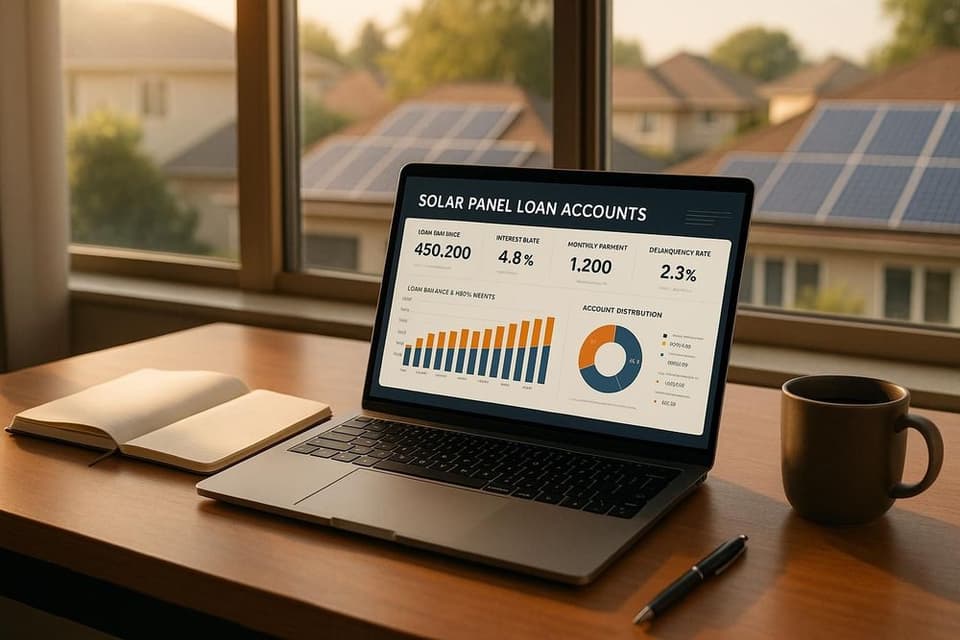
If you're managing solar panel loan accounts, understanding how to assess returns and risks is key. Here's a quick overview of what you need to know:
- Focus Areas:
- Financial Metrics: Use tools to calculate Net Present Value (NPV) and return projections.
- Risk Analysis: Monitor default rates and analyze loan vintages.
- Market Impact: Evaluate how solar installations boost property values and reduce utility costs.
- Top Tools and Features:
- Debexpert Platform: Offers portfolio analytics, compliance automation, and mobile integration.
- Stress Testing: Simulates market conditions to evaluate risks.
- Solar Performance Tools: Link energy production data to financial insights for sharper ROI predictions.
- Key Insights:
- Homes with solar panels sell for 4.1% more.
- Utility costs rise about 2% yearly, adding value to solar investments.
Quick Comparison of Tools
| Tool/Feature | Key Capability | Benefit |
|---|---|---|
| Debexpert | Portfolio analytics, compliance tools | Simplifies risk and compliance |
| SolarFarmer | Accurate energy yield modeling | Reliable performance forecasting |
| Sol Systems | Real-time weather and performance data | Financial insights from energy data |
| ACTIS | Project management optimization | Streamlines solar asset workflows |
| Solar-Log | Monitoring and feed-in management | Improves system efficiency |
To make the most of your solar loan portfolio, combine financial modeling, real-time data, and advanced analytics. Start with tools that integrate seamlessly into your workflow and help you manage risks while maximizing returns.
Solar Energy Financial Model Walkthrough
1. Debexpert Platform Features
Debexpert
Debexpert's platform offers tools tailored for analyzing solar loan portfolios. Below is an overview of its standout features, designed to help with accurate solar loan valuation.
The platform's valuation engine uses three integrated models specifically built for solar loan analysis:
| Analysis Component | Capabilities | Business Impact |
|---|---|---|
| Portfolio Analytics | Assesses defaults dynamically, generates vintage curves | Provides detailed risk evaluation across various loan vintages |
| Compliance Automation | Covers regulations in 19 states | Simplifies compliance for portfolios spanning multiple states |
| Mobile Integration | Supports offline contract review and field operations | Enhances on-site efficiency for field teams |
The platform also includes a risk assessment framework that incorporates solar-specific stress testing:
- Market Condition Variables Examines changes in net metering policies and utility rate shifts.
- Technical Performance Metrics Accounts for panel degradation and regional sunlight levels to refine long-term valuations.
- Security Protocols Uses end-to-end encryption to protect energy production data and personal information. It also handles solar project documentation, such as interconnection agreements, through its document management system.
On top of its analysis capabilities, the platform ensures data security and smooth integration. With CRM API connectivity, it integrates easily into existing portfolio management systems, simplifying the tracking and evaluation of residential solar assets.
For teams in the field, Debexpert offers mobile tools that allow them to:
- Review contracts without an internet connection
- Update asset-related documents
- Track performance metrics in real time
These features make it easier to analyze solar loans accurately, support informed decisions, and maintain compliance with regulations.
2. Online Portfolio Management Systems
Modern portfolio management systems, like those designed for platforms such as Debexpert, offer tools to evaluate solar loan performance, estimate returns, and manage risks. They use techniques like vintage analysis and stress testing to provide deeper insights, making them indispensable for today's portfolio management needs.
Vintage Analysis Integration These platforms use vintage curve tracking to analyze loans issued during the same time frame, helping forecast future performance. According to Finley Technologies:
"At their core, vintage curves track the performance of loans or investments that began at the same time...crucial information because it helps predict how current and future investments will likely perform based on historical trends."
Advanced Stress Testing Features Stress tests simulate various market conditions to assess how portfolios might hold up under pressure. For example, a Groundfloor analysis showed the following outcomes:
| Scenario | Loss Ratio |
|---|---|
| Severe Market Decline (22%) | 0.598% |
| Moderate Decline (5-10%) | 0.135% |
These results highlight how stress testing can quantify potential risks and portfolio durability in tough market conditions.
Risk Management Framework By integrating vintage analysis, these systems help financial institutions allocate appropriate reserves for potential loan losses. Finley Technologies explains:
"Vintage analysis helps banks and financial institutions manage risk and set aside appropriate provisions for loan losses."
Principal Protection Strategy A key focus of modern platforms is safeguarding investor capital. Advanced monitoring and policies prioritize security over repayment speed. Rich Pulido, Senior Vice President of Product and Strategy at Groundfloor, states:
"We are first and foremost concerned with protecting our investors' principal. We view that risk as primary over the timing of repayment. In distressed situations, our policies and practices reflect a preference for capital to be returned late and in full, rather than on-time and with a loss."
Additional features, like diversification tracking, help maintain balanced portfolios. Together, these tools create a robust system for managing solar loan portfolios effectively.
3. Solar Performance Analysis Tools
Solar performance analysis tools take technical data and turn it into actionable financial insights, building on earlier portfolio and risk assessments. These tools combine energy production metrics with external factors, offering vital information for evaluating loan portfolio risks.
Advanced Production Modeling DNV's SolarFarmer provides yield calculations with an accuracy of 0.1% compared to on-site measurements. This precision supports reliable forecasting of loan performance.
Weather Data and Performance Insights Real-time weather data has revolutionized how loan portfolios are evaluated. Sol Systems, managing a 7 GW portfolio, uses advanced monitoring to measure financial impacts. Adam Polis, Performance Engineering Manager at Sol Systems, explains:
"Quantifying the impact of a particular subcomponent of a system with minute-level granularity enables us to deliver high-quality, custom reports to our investors, with the flexibility to select any time frame we need."
Linking Technical Data to Financial Metrics Modern tools convert performance data into financial terms, helping to bridge technical insights with portfolio risks. Here's how:
| Analysis Component | Financial Impact Measure |
|---|---|
| Production Variance | Dollar value of output deviation |
| Equipment Outages | Real-time revenue loss calculation |
| Weather Effects | Revenue impact of climate events |
| System Optimization | ROI improvement potential |
This financial perspective enhances earlier risk and return analyses, making the data more actionable.
Risk Mitigation Features PlantPredict, developed by PV experts, continuously improves its energy modeling for large-scale projects.
Centralized Data Integration The success of solar performance analysis tools depends on consolidating data into a single, reliable source. Sol Systems emphasizes this approach:
"Centralizing all information into a single source of truth is critical to maintaining data integrity and quality."
Tool Comparison Matrix
Here’s a breakdown of specialized tools designed for managing solar loan portfolios. These tools bring unique features that can influence portfolio performance in various ways.
- ACTIS: Enhances project management processes, with some reports showing improvements of up to 77%.
- Solar-Log: Offers photovoltaic monitoring and feed-in management through its two solutions, Solar-Log Base and Solar-Log WEB Enerest™.
- PowerHub: Combines automated invoicing with contract and compliance management.
- LENS™: Delivers both compliance monitoring and real-time performance tracking in one platform.
Real-time monitoring and automated reporting are especially useful for centralizing data and identifying trends. These features add another layer of efficiency to the analytical capabilities we’ve already discussed.
"Using an advanced and efficient solar asset management tool can help you centralize data and manage tasks. In this way, you can save a significant amount of time." - SolarFeeds Magazine
When selecting a tool, portfolio managers should assess these features based on their specific operational needs to maximize returns.
Key Findings and Recommendations
The analysis highlights essential features for evaluating returns effectively, emphasizing the use of high-resolution aerial imagery for accurate solar design and forecasting.
To ensure accurate ROI calculations, analytical platforms should combine various data streams. Here are the key elements to consider:
| Analysis Component | Key Features |
|---|---|
| Load Profile Analysis | Includes EV charger integration and heat pump modeling |
| Battery Simulation | Models off-peak charging, time-of-use scenarios, and days-of-autonomy |
| Shading Analysis | Accounts for seasonal changes and uses real-time shadow modeling |
These elements lay the groundwork for actionable recommendations.
Portfolio managers should prioritize the following strategies:
- Interval Data Integration: Use detailed customer consumption data to enhance accuracy.
- Voltage Analysis: Conduct thorough assessments of cable paths to optimize system performance.
- Financial Modeling: Combine energy bills, consumption data, and production simulations for sharper ROI projections.
To streamline processes, analytical platforms should support API-driven workflow automation, enabling real-time portfolio adjustments. Merging financial projections with diverse data sources has proven to improve portfolio performance predictions.
FAQs
How does Net Present Value (NPV) help evaluate the profitability of solar panel loan accounts?
Net Present Value (NPV) is a key financial metric used to assess the potential returns of solar panel loan accounts. It represents the value of future cash flows - such as loan repayments or energy savings - discounted to their present value in dollars. By subtracting the initial investment cost from these discounted cash flows, NPV provides a clear picture of whether the investment is financially worthwhile.
A positive NPV indicates that the solar panel loan account is expected to generate a profit, while a negative NPV suggests a potential loss. This insight helps investors and lenders make informed decisions about the viability and profitability of their solar loan portfolios.
How does stress testing help manage risks in solar panel loan portfolios?
Stress testing plays a critical role in identifying and managing potential risks in solar panel loan portfolios. By simulating various scenarios - such as changes in weather patterns, equipment failure rates, or fluctuations in energy market prices - it helps assess how these factors could impact portfolio performance.
This type of analysis allows financial institutions to prepare for potential challenges, make informed decisions, and ensure the long-term stability of their investments in solar energy projects.
How do solar loan analysis tools turn technical data into meaningful financial insights for better portfolio management?
Solar loan analysis tools help transform complex technical data into clear, actionable financial insights to improve portfolio management. By analyzing factors like system performance, loan repayment trends, and market conditions, these tools provide a comprehensive view of portfolio health.
They assess risk using advanced methods like stress testing and simulations to predict potential challenges, such as energy production variability or system degradation. Additionally, they monitor key performance metrics to identify inefficiencies and support informed decision-making. These tools also calculate essential financial ratios, like the Debt Service Coverage Ratio (DSCR), to evaluate borrowers' ability to meet loan obligations, ensuring optimized returns and reduced risks.
